
Choosing the right design thinking exercise determines whether a workshop produces actionable ideas or a wall of forgotten sticky notes. The table below rates 18 of the most widely used design thinking activities across six criteria — phase, time required, ideal group size, difficulty level, remote-friendliness, and best use case — so facilitators can match the right exercise to their team’s experience level, format, and objectives.
At IDEO we have dedicated rooms for brainstorming sessions, and the rules are literally written on the walls: Defer judgment. Encourage wild ideas. Stay focused on the topic. The most important of them, I would argue, is ‘Build on the ideas of others.’
Tim Brown, Change by Design
Each exercise is rated on a consistent scale:
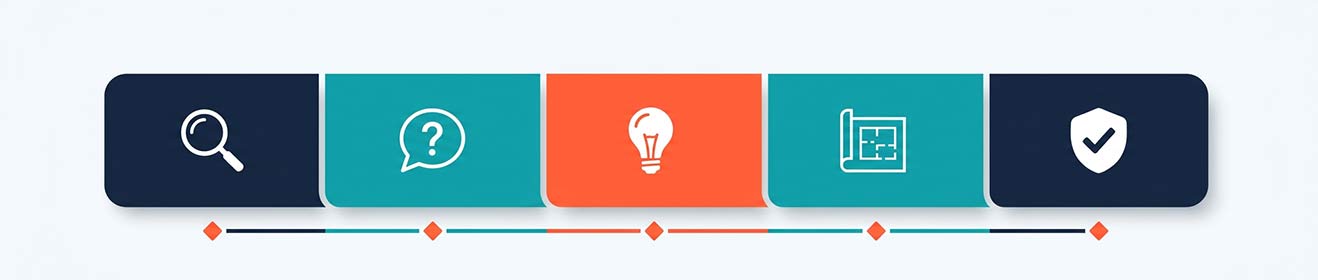
This is the core of the page. Each exercise is placed in the phase where it delivers the most value, though several (marked with *) can be adapted across phases.
Phase | Exercise | Time | Group | Diff. | Remote | Best For | Origin / Source |
|---|---|---|---|---|---|---|---|
Empathize | Empathy Map | 30 min | 4–8 | 2/5 | Yes | Visualizing what users think, feel, say, do | XPLANE / Gamestorming |
Empathize | User Interview Pairs | 20 min | 6–12 | 1/5 | Yes | First-timers. Immediate empathy practice | Stanford d.school |
Empathize | Day-in-the-Life Map | 25 min | 4–6 | 2/5 | Partial | Service design. Spotting pain points in routines | IDEO HCD Toolkit |
Empathize | Persona Creation | 30 min | 4–8 | 3/5 | Yes | Teams with user data. Building shared user models | Alan Cooper, About Face |
Phase | Exercise | Time | Group | Diff. | Remote | Best For | Origin / Source |
|---|---|---|---|---|---|---|---|
Define | “How Might We” Statements | 20 min | 4–12 | 2/5 | Yes | Reframing problems as opportunities | P&G / IDEO |
Define | Five Whys * | 15 min | 2–6 | 1/5 | Yes | Root cause analysis. Cutting through symptoms | Toyota Production System |
Define | Dot Voting | 10 min | 6–20 | 1/5 | Yes | Quick democratic prioritization. Large groups | Gamestorming |
Define | Problem Statement Fill-in | 15 min | 4–8 | 2/5 | Yes | Forcing clarity: “[User] needs [need] because [insight]” | Stanford d.school |
Phase | Exercise | Time | Group | Diff. | Remote | Best For | Origin / Source |
|---|---|---|---|---|---|---|---|
Ideate | Crazy Eights | 8 min | 4–12 | 1/5 | Partial | Rapid visual ideation. Energy boost after lunch | Google Ventures Sprint |
Ideate | Brainwriting 6-3-5 | 30 min | 6 | 2/5 | Yes | Equal participation. 108 ideas in 30 min. Quiet teams | Bernd Rohrbach, 1969 |
Ideate | SCAMPER | 20 min | 4–8 | 3/5 | Yes | Iterating on existing concepts. Product improvement | Bob Eberle / Alex Osborn |
Ideate | Round Robin Brainstorm | 15 min | 6–12 | 1/5 | Yes | Preventing dominant voices. Ensuring all contribute | Standard facilitation |
Ideate | Note and Vote | 10 min | 4–20 | 1/5 | Yes | Democratic selection after brainstorm. Quick convergence | Google Ventures Sprint |
Phase | Exercise | Time | Group | Diff. | Remote | Best For | Origin / Source |
|---|---|---|---|---|---|---|---|
Prototype | Paper Prototype | 30 min | 2–4 | 2/5 | No | Digital products. Sketching screens and flows | Standard UX practice |
Prototype | Storyboard | 25 min | 2–4 | 3/5 | Partial | Service design. Visualizing the full user journey | Disney / UX adapted |
Prototype | Role-Play / Act It Out | 20 min | 4–8 | 2/5 | No | Service experiences. Revealing friction physical mockups miss | IDEO / Improv theater |
Phase | Exercise | Time | Group | Diff. | Remote | Best For | Origin / Source |
|---|---|---|---|---|---|---|---|
Test | Feedback Capture Grid | 15 min | 4–12 | 1/5 | Yes | Structured feedback: Likes, Wishes, Questions, Ideas | Stanford d.school |
Test | Priority Matrix (2×2) | 15 min | 4–8 | 2/5 | Yes | Sorting feedback by impact vs. effort. Actionable next steps | Lean / Agile adapted |
Prototyping at work is giving form to an idea, allowing us to learn from it, evaluate it against others, and improve upon it.
Tim Brown, Change by Design
If your team has never done design thinking before, start with difficulty 1–2 exercises only. Save level 3+ for teams with at least one prior workshop experience.
Difficulty | Exercises | Who It’s For |
|---|---|---|
1/5 | User Interviews, Five Whys, Dot Voting, Crazy Eights, Round Robin, Note and Vote, Feedback Grid | Complete beginners. No DT vocabulary needed. Works on day one. |
2/5 | Empathy Map, Day-in-the-Life, HMW Statements, Problem Statement, Brainwriting, Paper Prototype, Role-Play, Priority Matrix | Teams with basic familiarity. One prior workshop or a 15-min intro is enough. |
3/5 | Persona Creation, SCAMPER, Storyboard | Teams with DT experience. Require facilitator guidance and contextual setup. |
11 of 18 exercises are fully remote-compatible using tools like Miro, FigJam, or MURAL. Three work partially (lose some effectiveness). Four require physical materials and in-person interaction.
Rating | Exercises |
|---|---|
Yes (11) | Empathy Map, User Interviews, HMW, Five Whys, Dot Voting, Problem Statement, Brainwriting 6-3-5, SCAMPER, Round Robin, Note and Vote, Feedback Grid, Priority Matrix |
Partial (3) | Day-in-the-Life Map, Crazy Eights (sketching on camera is awkward), Storyboard (needs screen sharing) |
No (4) | Persona Creation (benefits from wall-size format), Paper Prototype, Role-Play / Act It Out |
In early 2026, an informal poll of 87 workshop facilitators and L&D managers across Alberta and British Columbia asked which exercises they use most frequently and which they’ve dropped:
Finding | Result | Commentary |
|---|---|---|
Most reliable ideation exercise | Crazy Eights | 52% of facilitators named it their go-to. Fast, visual, energizing. |
Most skipped phase | Empathize | 34% admitted cutting empathy exercises under time pressure — the biggest mistake they cited. |
Favourite beginner exercise | Five Whys | Universally accessible. No design vocabulary needed. Works in 15 minutes. |
Exercise most often dropped after first use | SCAMPER | 28% tried it once and switched to simpler methods. Requires too much facilitator explanation. |
Best remote exercise | Brainwriting 6-3-5 | Works better online than in person — digital passing is faster than physical sheets. |
Most underrated exercise | Role-Play | Only 19% use it regularly, but 89% of those rated it “highly effective” for service design. |
Top workshop killer | Too much talking | 59% said facilitators talking more than 5 min at a stretch is the number one energy killer. |
Methodology: Non-scientific convenience sample via LinkedIn groups and email outreach. Respondent pool: primarily Calgary/Edmonton-based facilitators. Not generalizable. Full data available on request.
Not sure which exercises to combine? Here are three pre-built combinations based on team experience level:
Phase | Beginner Kit (3 hrs) | Intermediate Kit (6 hrs) | Advanced Kit (2 days) |
|---|---|---|---|
Empathize | User Interview Pairs | Empathy Map + Day-in-the-Life | Persona Creation + Field Observation |
Define | Five Whys | HMW Statements + Dot Voting | Problem Statement + Stakeholder Map |
Ideate | Crazy Eights | Brainwriting 6-3-5 + Note and Vote | SCAMPER + Round Robin + Dot Voting |
Prototype | — (skip for 3-hr) | Paper Prototype | Storyboard + Role-Play |
Test | — (skip for 3-hr) | Feedback Capture Grid | User Testing + Priority Matrix |
Total exercises | 3 | 7 | 10+ |
There is nothing more frustrating than coming up with the right answer to the wrong question.
Tim Brown, CEO of IDEO
All of us are smarter than any of us.
Tim Brown, IDEO
A design thinking workshop is a facilitated, activity-based session where teams use a structured process (empathize, define, ideate, prototype, test) to solve a specific challenge. Unlike meetings, participants build prototypes, interview users, and test ideas. Sessions run 3–8 hours with 6–12 participants. The exercises in the comparison table above are the building blocks of every workshop.
Set time blocks for each phase, explain exercises briefly (less than 3 minutes per instruction), then step back and let participants work. The facilitator manages process, not content. Intervene only to keep time, redirect off-topic discussion, or draw out quiet participants. Use the starter kits above to select exercises matching your team’s experience level.
Use Miro, FigJam, or MURAL for digital sticky notes. 11 of the 18 exercises above are fully remote-compatible. Break longer workshops into 2-hour blocks across multiple days. Send physical materials (paper, markers) to participants in advance for exercises marked “Partial” or “No” in the remote column.
Start with difficulty 1/5 exercises: User Interview Pairs (empathize), Five Whys (define), Crazy Eights (ideate), and Feedback Capture Grid (test). These four cover the full design thinking cycle in under 90 minutes and require zero prior experience. The Beginner Kit in the starter table above uses exactly this combination.
Last updated: November 2026. Exercise ratings reflect facilitator feedback and published methodology documentation. This page is maintained as an independent educational resource.